
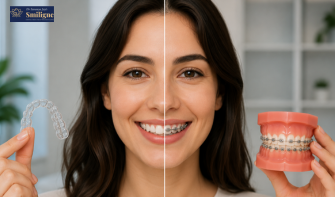
Many adults who want straighter teeth face the same question:
Should I choose Invisalign or traditional braces?
The answer is not always straightforward. Both options can successfully straighten teeth, correct bite problems, and improve smile aesthetics. However, they work differently, suit different lifestyles, and may be more effective for certain dental conditions.
This guide explains the key differences between Invisalign and braces, how each treatment works, and what adults should consider before making a decision.
Why More Adults Are Choosing Orthodontic Treatment
Orthodontic treatment is no longer just for teenagers.
Many adults seek treatment because of:
- Crowded teeth
- Gaps between teeth
- Overbites and underbites
- Relapse after childhood braces
- Difficulty cleaning misaligned teeth
- Jaw discomfort caused by bite issues
- Cosmetic concerns affecting confidence
Modern orthodontics offers more discreet and comfortable options than ever before, making treatment increasingly popular among working professionals, parents, and older adults.
What Is Invisalign?
Invisalign is a system of clear, removable aligners that gradually move teeth into their desired positions.
Instead of metal brackets and wires, Invisalign uses a series of custom-made transparent trays. Each aligner is worn for a specific period before moving to the next set.
The aligners are designed using digital scans and treatment-planning software that maps the expected movement of your teeth over time.
How Invisalign Works
- Digital scans are taken of your teeth.
- A customized treatment plan is created.
- Multiple aligners are fabricated.
- Each aligner gently shifts teeth.
- Aligners are changed approximately every 1 to 2 weeks.
- Treatment continues until the desired result is achieved.
What Are Traditional Braces?
Traditional braces use metal or ceramic brackets attached to the teeth and connected by wires.
The orthodontist periodically adjusts the wires to apply controlled forces that gradually move teeth into alignment.
Braces remain fixed to the teeth throughout treatment and cannot be removed by the patient.
How Braces Work
- Brackets are bonded to teeth.
- Archwires connect the brackets.
- Periodic adjustments are performed.
- Continuous pressure moves teeth.
- Treatment continues until alignment goals are achieved.
Invisalign vs Braces: Quick Comparison
| Feature | Invisalign | Traditional Braces |
|---|---|---|
| Appearance | Nearly invisible | Visible brackets and wires |
| Removability | Removable | Fixed |
| Eating Restrictions | Minimal | Several food restrictions |
| Oral Hygiene | Easier | More challenging |
| Comfort | Generally more comfortable | May cause irritation |
| Discipline Required | High | Low |
| Complex Cases | Some limitations | Handles most complex cases |
| Emergency Visits | Less common | More common |
| Speech Adjustment | Temporary lisp possible | Usually minimal |
| Visibility in Photos | Very discreet | Noticeable |
| Compliance Dependent | Yes | No |
Which Option Looks Better?
For many adults, appearance is one of the biggest deciding factors.
Invisalign
The aligners are made from clear plastic and fit closely over the teeth.
Many people may not notice them during conversations, meetings, or social events.
This makes Invisalign particularly attractive for:
- Professionals
- Public speakers
- Sales representatives
- Executives
- Adults concerned about aesthetics
Braces
Traditional metal braces are more noticeable.
However, ceramic braces use tooth-colored brackets and can be less visible than metal versions.
Winner for Appearance
Invisalign is generally the more discreet option.
Which Option Is More Comfortable?
Comfort varies between individuals, but there are some important differences.
Invisalign Comfort
Because there are no brackets or wires:
- Less irritation to cheeks and lips
- No wire poking
- Smooth plastic surfaces
- Gradual tooth movement
Most patients describe aligner pressure as mild to moderate when changing to a new tray.
Braces Comfort
Braces can sometimes cause:
- Soreness after adjustments
- Irritation inside cheeks
- Wire-related discomfort
- Bracket friction
Orthodontic wax can help reduce irritation.
Winner for Comfort
Most adults find Invisalign more comfortable.
Which Treatment Works Faster?
Many patients assume Invisalign is automatically faster.
This is not always true.
Treatment duration depends on:
- Severity of misalignment
- Bite problems
- Patient compliance
- Biological response to tooth movement
Typical Treatment Times
| Treatment | Approximate Duration |
|---|---|
| Mild Invisalign Cases | 6 to 12 months |
| Moderate Invisalign Cases | 12 to 18 months |
| Braces (Average Adult Case) | 12 to 24 months |
However, braces may move certain teeth more efficiently in complex cases.
Important Note
If Invisalign aligners are not worn as instructed, treatment may actually take longer than braces.
Which Option Is Better for Complex Cases?
This is where braces often maintain an advantage.
Braces May Be Better For
- Severe crowding
- Significant bite problems
- Large tooth rotations
- Teeth requiring substantial movement
- Complex orthodontic corrections
Invisalign May Be Suitable For
- Mild crowding
- Moderate crowding
- Small gaps
- Relapse after previous braces
- Many moderate bite corrections
Modern Invisalign technology can now treat cases that once required braces, but not every situation is identical.
A clinical assessment is needed to determine suitability.
The Biggest Factor Most Adults Overlook
Many adults focus only on appearance.
However, one overlooked factor is:
Compliance
Invisalign only works effectively when worn consistently.
Most providers recommend wearing aligners:
20 to 22 hours per day
That means removing them only for:
- Eating
- Drinking anything other than water
- Brushing
- Flossing
What Happens If You Don’t Wear Them Enough?
Potential issues include:
- Delayed treatment
- Poor tooth movement
- Additional aligners
- Increased costs
- Longer treatment duration
Braces eliminate this problem because they remain attached to the teeth.
If You Know You’re Forgetful
Braces may actually produce more predictable results.
Eating and Food Restrictions
This category often surprises adults.
Invisalign
Aligners are removed before meals.
You can generally continue eating:
- Apples
- Nuts
- Popcorn
- Steak
- Crunchy vegetables
No special dietary restrictions apply once aligners are removed.
Braces
Certain foods may damage brackets or wires.
Common foods often avoided include:
- Hard candy
- Popcorn
- Ice
- Sticky lollies
- Chewy caramel
- Hard nuts
Winner for Eating Convenience
Invisalign offers greater flexibility.
Which Is Easier to Keep Clean?
Good oral hygiene is critical during orthodontic treatment.
Invisalign
Since aligners are removable:
- Brushing remains normal
- Flossing remains easier
- Less plaque accumulation around appliances
Patients must also clean the aligners regularly.
Braces
Brackets and wires create areas where food and plaque can collect.
Additional tools may be required:
- Interdental brushes
- Water flossers
- Threaders
Winner for Oral Hygiene
Invisalign is generally easier to keep clean.
How Do Invisalign and Braces Affect Speech?
Speech changes are usually temporary.
Invisalign
Some patients notice:
- Mild lisping
- Changes in pronunciation
- Increased saliva initially
These effects often improve within days or weeks.
Braces
Speech changes can also occur but are typically mild.
Most adults adapt quickly regardless of treatment type.
Invisalign vs Braces Cost Comparison
Costs vary depending on:
- Case complexity
- Treatment length
- Geographic location
- Provider experience
A simple comparison looks like this:
| Factor | Invisalign | Braces |
|---|---|---|
| Mild Cases | Similar | Similar |
| Moderate Cases | Similar | Similar |
| Complex Cases | Sometimes higher | Often comparable |
| Repairs | Usually lower | May require additional visits |
| Replacement Costs | Lost aligners may incur fees | Broken brackets may require repair |
The most important consideration is often value rather than initial cost.
A treatment that effectively achieves the desired result can provide long-term benefits regardless of the appliance used.
Which Option Requires More Appointments?
Invisalign
Appointments are often:
- Less frequent
- Shorter
- More predictable
Braces
Appointments may involve:
- Wire adjustments
- Bracket repairs
- Emergency visits
Adults with busy schedules often appreciate the convenience of Invisalign.
What Happens After Treatment?
Regardless of which option you choose, treatment does not truly end when the teeth become straight.
Retainers Are Essential
Without retainers:
- Teeth can gradually shift
- Crowding may return
- Gaps may reopen
- Previous orthodontic results may relapse
Retention is one of the most important parts of long-term success.
Many adults seeking orthodontic treatment are actually correcting movement that occurred after not wearing retainers following childhood braces.
Invisalign vs Braces: Which Adults Typically Choose Each Option?
Adults Who Often Prefer Invisalign
- Professionals attending meetings regularly
- Adults concerned about appearance
- People comfortable following instructions
- Individuals wanting fewer food restrictions
- Patients with mild to moderate alignment issues
Adults Who Often Prefer Braces
- Adults with complex orthodontic problems
- Patients who prefer fixed treatment
- People concerned about forgetting aligners
- Individuals seeking highly controlled tooth movement
- Cases involving significant bite correction
Frequently Asked Questions
Is Invisalign painful?
Most patients experience mild pressure when changing aligners, but severe pain is uncommon.
Can Invisalign fix severe crowding?
Some severe cases can be treated with Invisalign, while others may respond better to braces. A clinical assessment is required.
Are braces more effective than Invisalign?
Not necessarily. Both can produce excellent outcomes when used appropriately for the right case.
Can adults get braces at any age?
Yes. Healthy teeth and gums are generally more important than age.
Which option gives the best cosmetic result?
Both can achieve excellent results. The quality of treatment planning and patient compliance often matter more than the appliance itself.
There is no universal winner in the Invisalign versus braces debate.
For adults prioritizing discretion, convenience, comfort, and easier oral hygiene, Invisalign is often an attractive choice.
For adults with significant crowding, complex bite issues, or concerns about consistently wearing removable aligners, traditional braces may offer a more predictable solution.
The best treatment depends on your specific dental condition, lifestyle, goals, and commitment to the process.
A comprehensive orthodontic assessment can help determine which option is likely to provide the safest, most effective, and most efficient outcome for your smile.